THE SHORT VERSION
What an Australian bra size calculator should tell you
Australia and New Zealand normally use the same bra size labels. The band is a dress-style number such as 8, 10, 12, or 14, while the cup uses letters such as A, B, C, D, DD, E, and F. A result such as AU 12D is therefore a useful starting label for an AU or NZ retailer, not a promise that every bra will fit identically.
Measure the underbust snugly in centimetres, measure the fullest part of the bust without compressing it, and then compare the result with the brand's own chart. The table below gives a practical regional conversion. It is deliberately conservative because fabric, cup shape, wire width, and grading can change the fit even when two labels look equivalent.
READ THE LABEL FIRST
How the AU/NZ bra size system works
The AU/NZ system combines a numeric band with a cup letter. The number is not the same number used on a US or UK label: AU/NZ 12 is commonly paired with a 34 band in US/UK-style tables, while AU/NZ 14 commonly pairs with 36. That is why a familiar US label can look surprisingly different after conversion.
Cup letters also need context. AU/NZ and UK charts often share the sequence A, B, C, D, DD, E, F, and beyond, but US and European charts may use different letters at fuller cups. Read the complete regional label rather than converting only the number or only the letter.
- Australia and New Zealand usually share the AU/NZ label family.
- The band number is a clothing-size style number, not a centimetre measurement.
- The cup letter describes volume relative to that band; it is not universal by itself.
- Use a retailer's chart when the brand uses an unusual fuller-cup sequence.
BAND AND CUP LOGIC
AU/NZ band and cup examples
A useful mental shortcut is that an AU/NZ band is often about 22 numbers lower than the corresponding US band: US 34 is commonly AU 12, and US 36 is commonly AU 14. This shortcut is only a band orientation. It does not replace a cup-by-cup conversion chart, especially above D where labels diverge between systems.
Brand charts frequently start with underbust ranges in centimetres. For example, one Australian brand's chart places an underbust of 73-77 cm around AU/NZ 12, while 78-82 cm sits around AU/NZ 14. Treat the range as a starting bracket and check the finished garment on your body.
- AU/NZ 8 is often paired with US/UK 30 in international tables.
- AU/NZ 10 is often paired with US/UK 32.
- AU/NZ 12 is often paired with US/UK 34.
- AU/NZ 14 is often paired with US/UK 36.
MEASURE BEFORE CONVERTING
How to measure an Australian bra size in centimetres
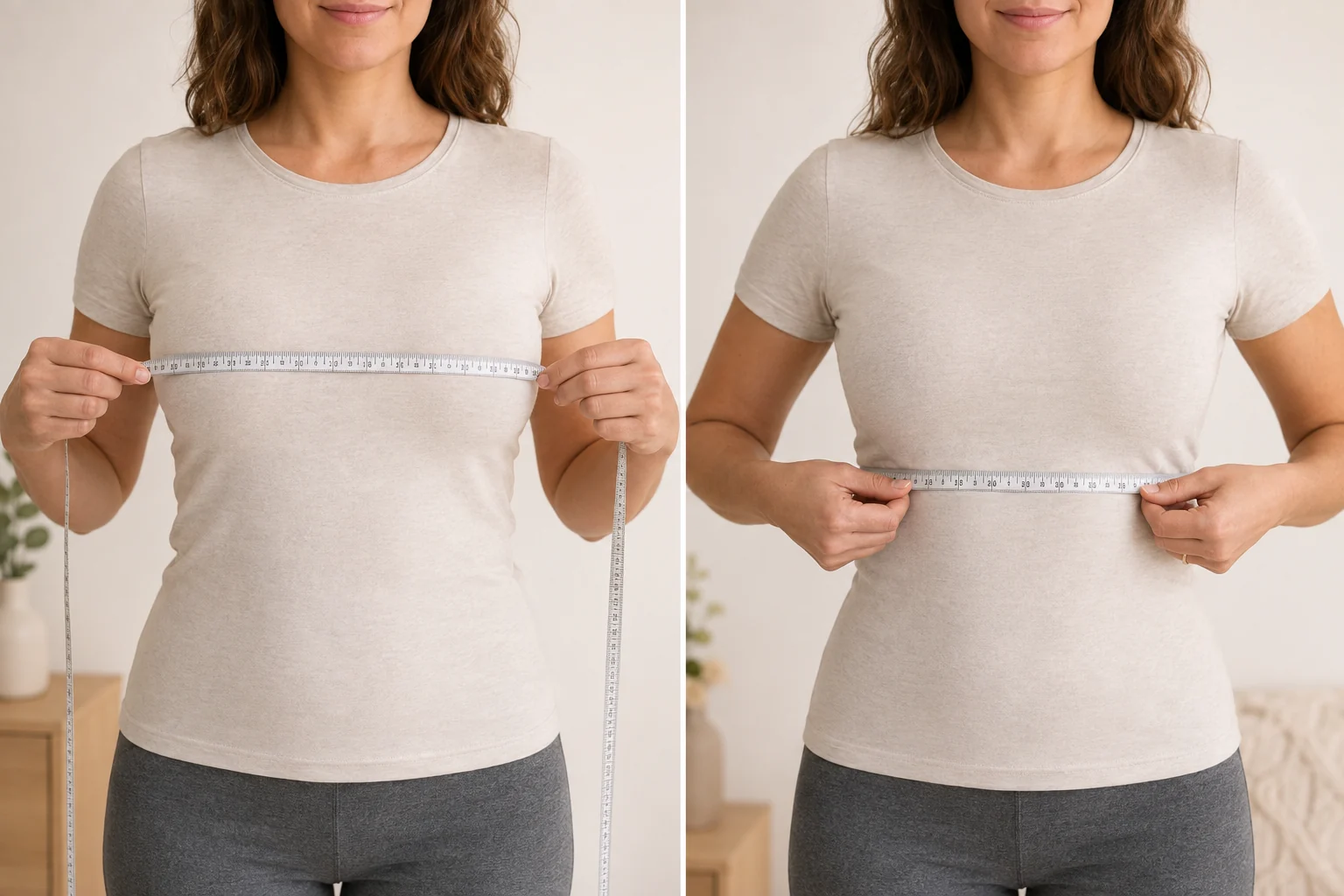
Centimetres are the most useful starting unit for many Australian and New Zealand retailer charts. Use a flexible tape and stand naturally. The tape should lie flat and stay parallel to the floor; pulling it tight, twisting it, or holding your breath can move the reading into a different band bracket.
Take each measurement twice. If the second reading changes by more than about a centimetre, reset your posture and tape position before using an Australian bra size calculator. The goal is a repeatable input, not a falsely precise number.
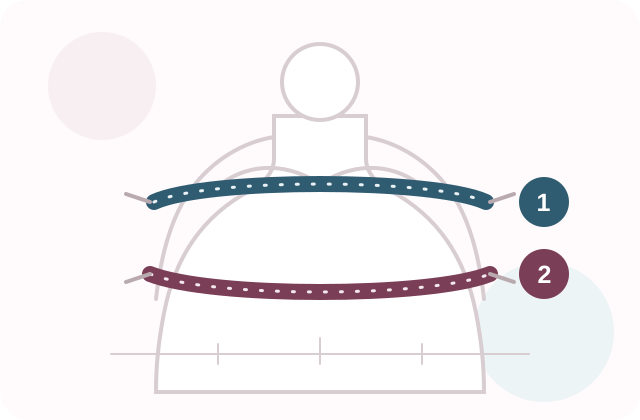
- Underbust: place the tape directly under the bust and keep it snug without digging in.
- Bust: measure around the fullest part while keeping the tape level and relaxed.
- Write both numbers in centimetres and keep the same unit for the whole conversion.
- If you are between rows, compare both neighbouring bands and the brand's return policy.
QUICK CONVERSION
AU/NZ bra size conversion chart
The rows below show common band relationships used by Australian and New Zealand retailers. The cup column stays intentionally simple because cup letters can diverge at fuller sizes. Use the row to orient yourself, then open the exact brand chart for the final letter.
For example, a US 34D may appear as AU/NZ 12D in a chart that keeps the UK/AU cup sequence. A European 75 band is often shown beside AU/NZ 12. These are labels for comparison, not a guarantee that the garments share the same pattern or support.
| AU/NZ | US/UK | EU band | Common cup note |
|---|---|---|---|
| 6 | 28 | 60 | A through D often align |
| 8 | 30 | 65 | Compare DD and fuller cups |
| 10 | 32 | 70 | Check the retailer sequence |
| 12 | 34 | 75 | A, B, C, D, DD, E are common |
| 14 | 36 | 80 | Fuller cups may use different letters |
| 16 | 38 | 85 | Check fit and the brand range |
| 18 | 40 | 90 | Use a size chart with centimetres |
AU/NZ and UK/India cup letters often track closely in published tables, but US, EU, and individual brands can label fuller cups differently. Never buy from the number alone.
A REPEATABLE WORKFLOW
How to use an Australian bra size calculator
A calculator is most helpful when it reduces a regional-label problem to a short, visible workflow. Keep the measurement notes beside you and record the sizing system that the shop actually uses. If the shop says AU/NZ, do not paste a US result into the checkout field without converting it.
The following sequence works for a new purchase, a size check after body changes, or a conversion from a US or UK label.
- 1. Measure the band areaRecord the snug underbust in centimetres directly below the bust. Keep the tape level and relaxed enough to breathe normally.
- 2. Measure the fullest bustRecord the bust at its fullest point without compressing the tissue. Repeat the reading if the tape slips or tilts.
- 3. Choose AU/NZUse the AU/NZ column or the Australian setting when the retailer uses dress-style bands such as 10, 12, or 14.
- 4. Compare the cupRead the cup row as well as the band row. Above D, check whether the brand uses DD, E, F, or another sequence.
- 5. Test the garmentCheck the band, cup edge, gore, straps, and movement. Keep the size that feels supportive and comfortable in that specific style.
THE LABEL IS A START
Use the result with a retailer size chart
A calculated AU/NZ label is a shopping starting point. It cannot see whether a particular cup is shallow or projected, whether the wire is narrow, or whether a stretch fabric will relax after wear. Those details explain why two bras with the same printed size can feel different.
Try the garment on the loosest hook when it is new, keep the band level, and make sure the cup contains the breast without spilling or collapsing. A nearby sister size can help when the cup volume feels close but the band tension does not.
The same printed number can still feel different in a sports style, an underwired style, or a stretchy fabric. When ordering online, record the measurement date, sizing system, and brand row so that an exchange has a clear starting point.
- The band should stay level and feel firm without causing sharp pressure.
- The cup edge should lie smoothly rather than cutting in or leaving a large gap.
- The centre gore should sit comfortably when the style includes one.
- Straps should support without carrying the entire weight of the garment.
- Use the store's return policy when a measurement sits on a boundary.
AU/NZ BRA SIZE FAQ
Frequently asked questions
These answers cover the regional labels, measurement units, conversions, and practical limits that commonly cause confusion.
Do Australia and New Zealand use the same bra sizes?
They normally use the same AU/NZ band and cup labels, so an AU 12D is generally read as NZ 12D. Individual brands can still grade or fit the garment differently.
What is a US 34 in Australian bra sizing?
A US 34 band is commonly shown as AU/NZ 12. Check the cup row separately because fuller-cup letters may differ between US and AU/UK charts.
Can I measure an Australian bra size in inches?
Yes. You can measure in inches and convert to a chart, but centimetres usually match Australian retailer tables more directly. Do not mix inches for one field and centimetres for the other.
Why does my Australian cup letter change after conversion?
Cup letters are relative to the band and each system uses its own sequence. A US DDD/F or an EU E may appear under a different AU/UK letter even when the intended volume is similar.
Is an Australian bra size calculator exact?
No general calculator can guarantee one exact fit. It gives a measured starting point; the brand chart, garment shape, tape technique, and real try-on determine whether the size works.
What should I do when I am between AU/NZ bands?
Repeat both measurements, compare the neighbouring band rows, and inspect the brand's centimetre range. You can also try a sister size, but keep the same cup-volume expectation in mind.
Should I use a brand's own Australian chart?
Yes. Use this guide to understand the regional label, then use the brand's own chart for the actual order because materials, patterns, and fuller-cup naming vary.
CHECK THE ORIGINAL TABLE
Sources and limits
The regional relationships in this guide are compared with published retailer charts. The linked chart is a useful reference, but it is not a universal standard for every AU or NZ brand.
- Berlei Australian bra sizes and fitting guideA first-party brand chart showing centimetre underbust ranges, AU/NZ bands, and cup columns.
- Bra Size Calculator homepageUse the site's general calculator when you need a browser-based US, UK, or EU starting-size estimate.