
Prepare the tape
Stand naturally with relaxed shoulders. Keep the tape flat and parallel to the floor, using the same unit for both fields.
PRIVATE, PRACTICAL, EXPLAINED
Find a recommended starting size from two simple measurements. Enter your underbust and bust, choose a sizing system, and compare the result with nearby sister sizes before you shop.
STEP 1
STEP 2
Recommended starting size
32DUS / CA · Inches
This measurement is close to a common size boundary. Compare the adjacent sister size and the brand chart when you shop.
Bra sizing is not perfectly standardized. Check the brand's own size chart because fabric, cup shape, and style can change the fit.
Example result. Enter measurements to calculate.
Choose units and system, then enter both measurements.
GET A REPEATABLE MEASUREMENT
A useful bra size calculator starts with two relaxed, level measurements. Use a flexible tape, keep the unit consistent, and do not pull so tightly that the tape changes what you are measuring.
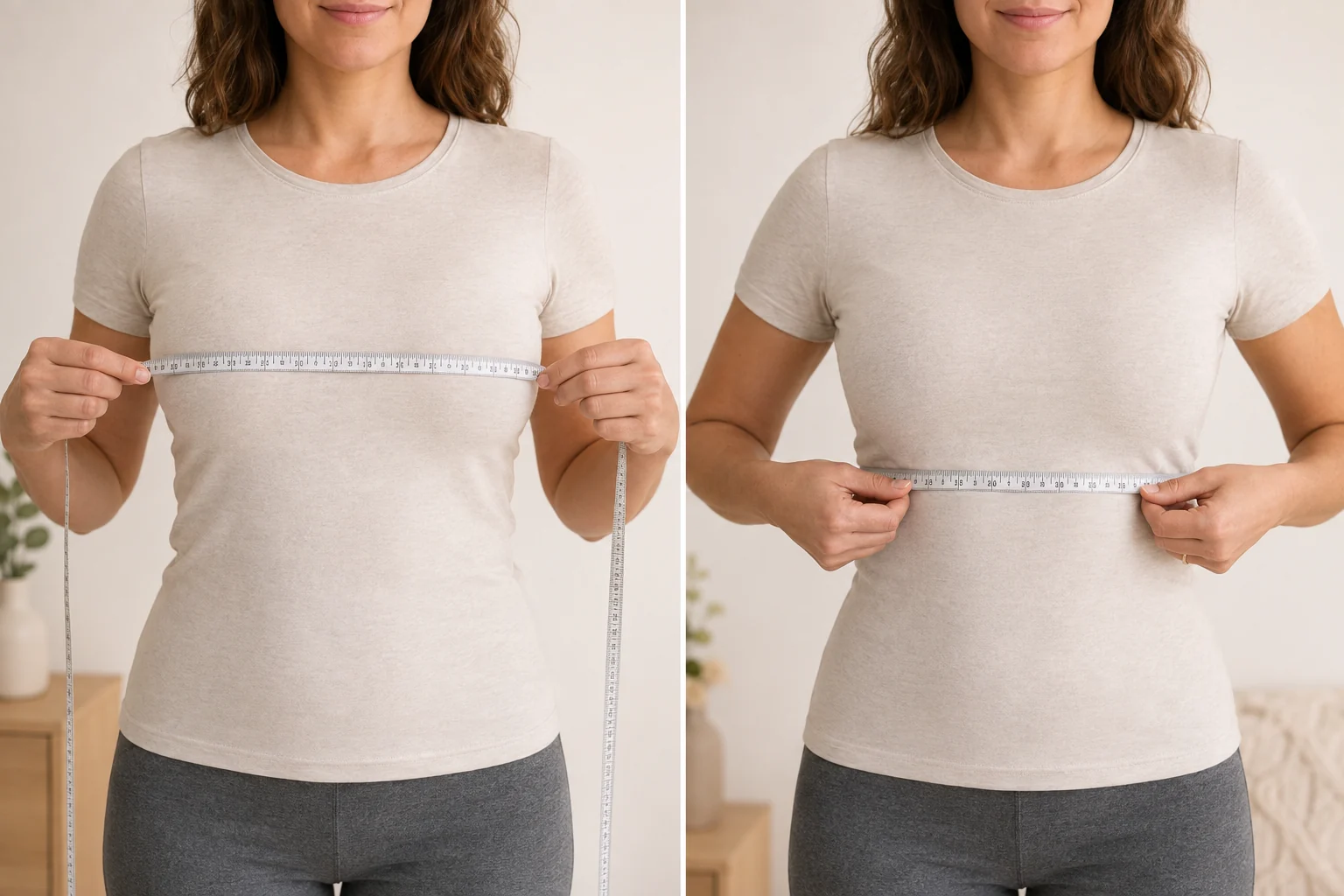
In the first view, the tape goes around the fullest part of the bust. In the second, it sits snugly around the ribcage directly under the bust. Keep it level.
Stand naturally with relaxed shoulders. Keep the tape flat and parallel to the floor, using the same unit for both fields.
Wrap the tape snugly around your ribcage, directly under your bust. Keep it level and record the number before rounding.
Measure around the fullest part of your bust while keeping the tape level. Let it touch without pressing or compressing.
A CLEAR ESTIMATE, NOT A PROMISE
The calculator normalizes inches and centimeters, maps the ribcage measurement to a band range, and compares the bust-to-band difference with the selected cup sequence. US / CA, UK, and EU conventions can show different labels for the same measurements, so the result is a starting point to compare with a brand chart and real fit check.
Changing the display unit does not change the underlying measurements, so repeated conversions do not drift.
Band numbers and cup letters follow the selected US / CA, UK, or EU convention rather than one universal chart.
The result adds sister sizes, a measurement summary, and a short fit check for the next shopping decision.
USE THE RESULT WELL
A bra size combines a band label with a cup label. The number follows the selected system's band convention, while the letter describes the relative difference between the band area and bust. Changing the band can change the letter while keeping a similar cup volume.
Use the displayed size as the first one to try. Assess the band, cups, and comfort together rather than judging the label alone.
Sister sizes keep a similar cup volume while changing the band: a smaller band usually moves up one cup letter, and a larger band moves down one.
Move and sit while checking a level band, contained cups, and comfortable straps. These checks matter more than a label guarantee.
WHY LABELS CHANGE
Sizing systems are related, but their labels are not interchangeable. Band numbers and cup sequences vary, so match the calculator system to the store or brand chart.
US / CA bands commonly use even numbers in inches. Cup sequences may run AA, A, B, C, D, DD, then DDD/F and larger labels; check the retailer's chart.
UK uses familiar band numbers but a different cup sequence, including DD, FF, and GG. A similar-looking number may need a different cup label.
EU bands commonly use five-centimeter steps such as 70, 75, 80, and 85. Read the EU cup letter with an EU chart instead of copying a US letter.
A QUICK REFERENCE
This compact chart explains the calculator's common range. Use it to read a result, then measure and check the brand-specific chart.
| Band examples | Cup sequence examples | How to use it |
|---|---|---|
| 28–32 / 60–70 | AA, A, B, C, D | Smaller band labels; compare nearby sister sizes when the band feels too tight or loose. |
| 34–38 / 75–85 | C, D, DD, E, F | Common middle ranges; the displayed letter depends on the selected system. |
| 40–44 / 90–100 | D, DD, E, F, FF | Use the same region convention when comparing an EU, UK, or US label. |
| 46–52 / 105–120 | DD, E, F, G, GG | For extended bands, verify the brand's available range and fit notes. |
Cup letters are relative to the band and are not universal across sizing systems.
SET THE RIGHT EXPECTATION
It can give you a useful starting point when measurements are careful, but no general calculator guarantees one size for every person, brand, or style. Tape tension, posture, shape, padding, and stretch can move a result across a boundary.
Use the result as a shopping shortcut: try it first, compare sister sizes when the band or cup feels off, and check the retailer's chart. Measure again when your fit needs change.
Measure twice if the number feels surprising.
Compare fit on the loosest hook when a new bra is unworn.
Do not judge the band separately from the cups and comfort.
LOCAL BY DESIGN
This bra size calculator runs the conversion and size mapping in your browser. It needs no photo, camera, account, email, or upload, and it does not place measurements in the URL.
This is a clothing fit estimate, not a medical or body assessment. The page avoids scores and judgments and does not create a public measurement profile.
The calculator only asks for two numeric measurements.
You can calculate, edit, and compare without signing in.
The size estimate is generated by the page in your browser.
WHEN THE RESULT LOOKS WRONG
Surprising results usually come from a unit mismatch, an uneven tape, or the wrong regional chart. Correct the input and calculate again.
Enter digits with an optional decimal point, such as 32 or 81.5. Leave the unit symbol out.
Try this: Choose Inches or Centimeters above the fields and use that unit in both measurements.
The two tape positions measure different points, so bust should be greater than snug underbust.
Try this: Recheck the tape positions and make sure you did not swap the two fields.
That is expected: US / CA, UK, and EU charts use different band and cup conventions for the same measurements.
Try this: Use the system that matches the brand chart you are about to read.
A label cannot account for every cup shape, wire width, fabric, or preference, especially near a boundary.
Try this: Try the displayed sister size, repeat the measurement, and compare the brand's fit guidance.
BRA SIZE CALCULATOR FAQ
These answers cover measuring, regional labels, sister sizes, accuracy, privacy, and what to try when a size is not comfortable.
Measure your underbust snugly and your bust at the fullest point using one unit. Enter both numbers, select US / CA, UK, or EU sizing, and use the output as a starting size.
Use whichever unit is easiest to measure accurately. Both fields must use the same unit; choose the store's unit when comparing charts.
They use different band conventions and cup sequences. Read each label with its own chart and select the system used by the brand or retailer.
They are nearby labels with similar cup volume but a different band. Moving down in band usually moves up one cup letter; moving up usually moves down one.
Brands use different cuts, cup shapes, fabrics, and fit preferences. Start here, check the brand chart, and compare a sister size if needed.
It narrows down where to start, but it is not a guarantee. Tape tension, posture, construction, and size boundaries can change the fit.
Yes. It uses only the two numbers you enter and runs in your browser without a photo, camera, account, or upload.
Yes. It shows nearby sister sizes with similar cup volume and a different band. Compare them with the brand chart.
NEXT SHOPPING STEP
Keep the sizing system visible as you compare a try-on or online order. Choose the size that feels supportive and comfortable in the garment.